Home Maintenance How to clean solar panels

How to clean solar panels

9
20

A dirty solar panel is an inefficient one: dirty solar panels will produce less power than clean ones, which may even cost you money over time. Find out how – and how often – to clean your solar panels.

Solar panel cleaning 

Roofs are dangerous places – it’s best to leave cleaning to a professional if you aren’t properly trained to work at heights.

Solar panels are built to withstand constant exposure to the elements, but from time to time they will need to be cleaned to maintain maximum efficiency. A dirty solar panel will generate considerably less power, and if you live in a dusty area or one with a lot of leaf litter, you will need to keep an eye on them to make sure they are clean and clear.


Safety first

There are a number of things you’ll need to consider when it comes to safety; cleaning a solar panel involves introducing water to an electrical system, typically located high up on a roof. The first recommendation we can make is that you don’t even try it yourself unless you’re trained to work at heights, wearing the right safety gear, and have all of the necessary instruction from the manufacturer and installer.

A misstep could easily send you off and injure or kill you; there’s a very good reason that tradespeople go through the necessary training and wear the right safety gear when they get up on roofs! Commercial solar panel cleaning services are available for a fairly reasonable price these days – if you’re shopping around for one, weigh the cost of the energy you’re losing against the cost of the service.


Manufacturer’s instructions

Different systems will have different coatings and materials, and as a result will need to be cleaned with the right cleaning agents and materials. A scourer, for example, may damage the panels and reduce their efficacy – but so may different cleaning chemicals. If you’re working with soapy water be extremely careful with your footing.

If you are able to access your solar panels safely (perhaps even with a telescopic brush), you’ll still need to be extremely careful because you’re working with high powered electrical equipment. Check the maintenance advice that came with your solar panels – or if you can’t do that, get some written instructions from the company that supplied them to you before you attempt to clean them.

You should always fully switch off any electrical systems before you attempt to clean them. If there are any cracks in the panels, the wiring underneath could be exposed, which could deliver a powerful electric shock if still connected to the battery when you wash them. Likewise, if you have a transformerless inverter, there’s a risk of electrostatic shock if the frame on the panels isn’t properly earthed. And even if they are switched off, there’s a good chance that the solar panels will be dangerously hot.

A properly trained solar panel cleaner will be well aware of the risks involved, will work methodically with the right safety precautions, and will offer a warranty on his or her services for extra peace of mind.


Frequency, materials and technique

Solar panels should be cleaned around every six months under normal conditions, as dust build-up and other detritus like bird poo can reduce a panel’s efficiency even if it’s not completely obvious how dirty the panel is. There’s nothing stopping you from cleaning your panels more frequently, but it’s worth considering that the more contact you have with the panels, the greater the risk that you’ll damage them.

Most solar panels are made of toughened glass which has a coating that’s susceptible to scratching, so under no circumstances should abrasives be used. The cleaning implement of choice is normally a soft brush; a scour pad is too abrasive, while a sponge or squeegee will not get at the tougher baked in stains. Plain water is normally used to avoid any chemical residue build up from a soap or cleaning chemicals.

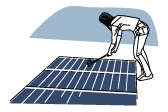
Small circular strokes are normally sufficient to loosen most of the dirt to the point where it can be hosed off or washed away. The panels are normally dried off as soon as possible after washing to prevent any calcium deposits in the water from building up. A glass polishing cloth or similar is normally used for this purpose.
20 COMMENTS

  1. Regarding solar panels, some
    Regarding solar panels, some time back a friend was told that only experts in solar paneling should clean them for a fee.
    That of course is a lie, no one should be charged, unless you’re trained to work at heights, wearing the right safety gear. Then you would have to pay.
    I have used a step ladder and a powerful house to wash mine plus the hot solar panel. So long has you keep the water on the panels it should be ok, have been doing this for 3 years now and have never had a problem.
    Brian Edwards WA.

  2. Regarding solar panels, some
    Regarding solar panels, some time back a friend was told that only experts in solar paneling should clean them for a fee.
    That of course is a lie, no one should be charged, unless you’re trained to work at heights, wearing the right safety gear. Then you would have to pay.
    I have used a step ladder and a powerful house to wash mine plus the hot solar panel. So long has you keep the water on the panels it should be ok, have been doing this for 3 years now and have never had a problem.
    Brian Edwards WA.

  3. Regarding solar panels, some
    Regarding solar panels, some time back a friend was told that only experts in solar paneling should clean them for a fee.
    That of course is a lie, no one should be charged, unless you’re trained to work at heights, wearing the right safety gear. Then you would have to pay.
    I have used a step ladder and a powerful house to wash mine plus the hot solar panel. So long has you keep the water on the panels it should be ok, have been doing this for 3 years now and have never had a problem.
    Brian Edwards WA.

  4. Regarding solar panels, some
    Regarding solar panels, some time back a friend was told that only experts in solar paneling should clean them for a fee.
    That of course is a lie, no one should be charged, unless you’re trained to work at heights, wearing the right safety gear. Then you would have to pay.
    I have used a step ladder and a powerful house to wash mine plus the hot solar panel. So long has you keep the water on the panels it should be ok, have been doing this for 3 years now and have never had a problem.
    Brian Edwards WA.

  5. I’d like to offer some first
    I’d like to offer some first hand info on cleaning solar panels. Tap water is a negative unless you can manually remove/dry it immediately. If allowed to air dry the mineral deposits left behind simply hold more dirt going forward and they are almost impossible to get off. Soap/chemicals can be an effective cleaner but how do you then get rid of the residue? The hose? Right back where you started from. This works just like hosing off your car or the windows on your house and letting it air dry. R/O or deionized water (used in the window cleaning industry) is the only way to really get them clean and leave nothing behind but sparkling panels.
    Please see http://cleansolarpanels.net for more information.

  6. I’d like to offer some first
    I’d like to offer some first hand info on cleaning solar panels. Tap water is a negative unless you can manually remove/dry it immediately. If allowed to air dry the mineral deposits left behind simply hold more dirt going forward and they are almost impossible to get off. Soap/chemicals can be an effective cleaner but how do you then get rid of the residue? The hose? Right back where you started from. This works just like hosing off your car or the windows on your house and letting it air dry. R/O or deionized water (used in the window cleaning industry) is the only way to really get them clean and leave nothing behind but sparkling panels.
    Please see http://cleansolarpanels.net for more information.

  7. I’d like to offer some first
    I’d like to offer some first hand info on cleaning solar panels. Tap water is a negative unless you can manually remove/dry it immediately. If allowed to air dry the mineral deposits left behind simply hold more dirt going forward and they are almost impossible to get off. Soap/chemicals can be an effective cleaner but how do you then get rid of the residue? The hose? Right back where you started from. This works just like hosing off your car or the windows on your house and letting it air dry. R/O or deionized water (used in the window cleaning industry) is the only way to really get them clean and leave nothing behind but sparkling panels.
    Please see http://cleansolarpanels.net for more information.

  8. I’d like to offer some first
    I’d like to offer some first hand info on cleaning solar panels. Tap water is a negative unless you can manually remove/dry it immediately. If allowed to air dry the mineral deposits left behind simply hold more dirt going forward and they are almost impossible to get off. Soap/chemicals can be an effective cleaner but how do you then get rid of the residue? The hose? Right back where you started from. This works just like hosing off your car or the windows on your house and letting it air dry. R/O or deionized water (used in the window cleaning industry) is the only way to really get them clean and leave nothing behind but sparkling panels.
    Please see http://cleansolarpanels.net for more information.

  9. Unless the rain will do it
    Unless the rain will do it for me. I work of a step ladder with wife turning on the water. We have great results with our bills.

  10. Unless the rain will do it
    Unless the rain will do it for me. I work of a step ladder with wife turning on the water. We have great results with our bills.

  11. Unless the rain will do it
    Unless the rain will do it for me. I work of a step ladder with wife turning on the water. We have great results with our bills.

  12. Unless the rain will do it
    Unless the rain will do it for me. I work of a step ladder with wife turning on the water. We have great results with our bills.

  13. The effects of heat on solar
    The effects of heat on solar panels is pretty well documented but not well explained or even mentioned to most solar owners. The fact is heat is the enemy and light is their friend. What also isn’t widely known is that dirty panels block light and hold heat, the exact opposite of what we want.
    We conducted some tests and found that the average drop in panel temperature was 12.5* after cleaning. Here’s an excerpt from

    https://www.civicsolar.com/support/installer/articles/how-solar-panel-temperature-affects-efficiency

    For example, the temperature coefficient of a Sharp Solar Panel NU-U230F3 is -.485% per 1 degree Celsius. So, for every degree above 25°C, the maximum power of the Sharp solar panel falls by .485%, for every degree below, it increases by .485%. What this means no matter where you are, your panel may be affected by seasonal variations.

    25*C is about 77* fahrenheit, a pretty modest temp for our area (southern Arizona) We’ve temped panels on relatively cool days for here, 80’s, and have seen some panel temps as high as 130*, wasn’t even hot out. So, if you lose .485% for every degree over 77* on a mild day that can easily reach the 25% range. Our readings indicate that on average we can cut that in half by cleaning. Deionized water, no chemicals, no residue or spots. Here is an example of some of our recorded temps.

    Panel Temps
    Dirty Clean Difference
    81.6 70.1 11.5
    122.5 113.1 9.4
    134.7 120.7 14
    89.7 76.8 12.9
    78.8 66.3 12.5
    73 63 10
    104 93 11
    107 95.5 11.5
    84.3 72.1 12.2

    cleansolarpanels.net facebook.com/purecleansolarservices.com

  14. The effects of heat on solar
    The effects of heat on solar panels is pretty well documented but not well explained or even mentioned to most solar owners. The fact is heat is the enemy and light is their friend. What also isn’t widely known is that dirty panels block light and hold heat, the exact opposite of what we want.
    We conducted some tests and found that the average drop in panel temperature was 12.5* after cleaning. Here’s an excerpt from

    https://www.civicsolar.com/support/installer/articles/how-solar-panel-temperature-affects-efficiency

    For example, the temperature coefficient of a Sharp Solar Panel NU-U230F3 is -.485% per 1 degree Celsius. So, for every degree above 25°C, the maximum power of the Sharp solar panel falls by .485%, for every degree below, it increases by .485%. What this means no matter where you are, your panel may be affected by seasonal variations.

    25*C is about 77* fahrenheit, a pretty modest temp for our area (southern Arizona) We’ve temped panels on relatively cool days for here, 80’s, and have seen some panel temps as high as 130*, wasn’t even hot out. So, if you lose .485% for every degree over 77* on a mild day that can easily reach the 25% range. Our readings indicate that on average we can cut that in half by cleaning. Deionized water, no chemicals, no residue or spots. Here is an example of some of our recorded temps.

    Panel Temps
    Dirty Clean Difference
    81.6 70.1 11.5
    122.5 113.1 9.4
    134.7 120.7 14
    89.7 76.8 12.9
    78.8 66.3 12.5
    73 63 10
    104 93 11
    107 95.5 11.5
    84.3 72.1 12.2

    cleansolarpanels.net facebook.com/purecleansolarservices.com

  15. The effects of heat on solar
    The effects of heat on solar panels is pretty well documented but not well explained or even mentioned to most solar owners. The fact is heat is the enemy and light is their friend. What also isn’t widely known is that dirty panels block light and hold heat, the exact opposite of what we want.
    We conducted some tests and found that the average drop in panel temperature was 12.5* after cleaning. Here’s an excerpt from

    https://www.civicsolar.com/support/installer/articles/how-solar-panel-temperature-affects-efficiency

    For example, the temperature coefficient of a Sharp Solar Panel NU-U230F3 is -.485% per 1 degree Celsius. So, for every degree above 25°C, the maximum power of the Sharp solar panel falls by .485%, for every degree below, it increases by .485%. What this means no matter where you are, your panel may be affected by seasonal variations.

    25*C is about 77* fahrenheit, a pretty modest temp for our area (southern Arizona) We’ve temped panels on relatively cool days for here, 80’s, and have seen some panel temps as high as 130*, wasn’t even hot out. So, if you lose .485% for every degree over 77* on a mild day that can easily reach the 25% range. Our readings indicate that on average we can cut that in half by cleaning. Deionized water, no chemicals, no residue or spots. Here is an example of some of our recorded temps.

    Panel Temps
    Dirty Clean Difference
    81.6 70.1 11.5
    122.5 113.1 9.4
    134.7 120.7 14
    89.7 76.8 12.9
    78.8 66.3 12.5
    73 63 10
    104 93 11
    107 95.5 11.5
    84.3 72.1 12.2

    cleansolarpanels.net facebook.com/purecleansolarservices.com

  16. The effects of heat on solar
    The effects of heat on solar panels is pretty well documented but not well explained or even mentioned to most solar owners. The fact is heat is the enemy and light is their friend. What also isn’t widely known is that dirty panels block light and hold heat, the exact opposite of what we want.
    We conducted some tests and found that the average drop in panel temperature was 12.5* after cleaning. Here’s an excerpt from

    https://www.civicsolar.com/support/installer/articles/how-solar-panel-temperature-affects-efficiency

    For example, the temperature coefficient of a Sharp Solar Panel NU-U230F3 is -.485% per 1 degree Celsius. So, for every degree above 25°C, the maximum power of the Sharp solar panel falls by .485%, for every degree below, it increases by .485%. What this means no matter where you are, your panel may be affected by seasonal variations.

    25*C is about 77* fahrenheit, a pretty modest temp for our area (southern Arizona) We’ve temped panels on relatively cool days for here, 80’s, and have seen some panel temps as high as 130*, wasn’t even hot out. So, if you lose .485% for every degree over 77* on a mild day that can easily reach the 25% range. Our readings indicate that on average we can cut that in half by cleaning. Deionized water, no chemicals, no residue or spots. Here is an example of some of our recorded temps.

    Panel Temps
    Dirty Clean Difference
    81.6 70.1 11.5
    122.5 113.1 9.4
    134.7 120.7 14
    89.7 76.8 12.9
    78.8 66.3 12.5
    73 63 10
    104 93 11
    107 95.5 11.5
    84.3 72.1 12.2

    cleansolarpanels.net facebook.com/purecleansolarservices.com

Comments are closed.